
India, one of the fastest growing economies in the world, is facing a slowdown in a sign of deeper problems.

Domestic consumption is slowing down in India, revealing a larger problem behind the economic slowdown [File: Francis Mascarenhas/Reuters]
Hours before Indian Prime Minister Narendra Modi’s visit to the White House, President Donald Trump announced that the United States would levy reciprocal tariffs on its trading partners.
It could hardly have come at a tougher time for India, which is already pressed by a slowing economy and sluggish demand.
Recommended Stories
- Left in the lurch: Asylum seekers respond to Trump’s CBP One cancellation
Trump’s tariffs could spur push to rewrite North America trade pact
Can AI and automated planes help prevent plane crashes?
US Vice President JD Vance blasts Europe over free speech, lax migration
At a joint news conference, Trump said India would buy F-35 fighter jets and oil and gas from the US. The two countries would also begin negotiations on the US trade deficit with India.
India runs a large trade surplus with the US and such negotiations and military and oil purchases could adversely impact its economy at a time when it is going through a slowdown.
With the Indian economy expected to grow at 6.4 percent in the year ending March, its slowest in four years, the Modi government announced income tax relief for the middle class in the annu.al budget earlier this month
Days later, the country’s central bank cut its benchmark interest rate for the first time in nearly five years by 0.25 percent to 6.25 percent with Governor Sanjay Malhotra saying a less restrictive monetary policy was more appropriate in light of the current “growth-inflation dynamics”.
Economists warn the tax relief may not be enough for the vast majority of Indians, whose income still falls below taxable limits and who may still be reeling from the impact of the COVID pandemic, which devastated their earnings.
“There is a vast base [of people] where recovery has not come back after the pandemic,” says Kaushik Basu, professor of economics at Cornell University. “We see this in data that the agricultural labour base has increased. And agriculture may well be just a parking spot.”
Basu was referring to people who left urban jobs during India’s tight and prolonged COVID lockdown and returned to their villages. Without enough well-paying jobs to return to in cities, they have stayed in their villages doing seasonal agricultural labour.
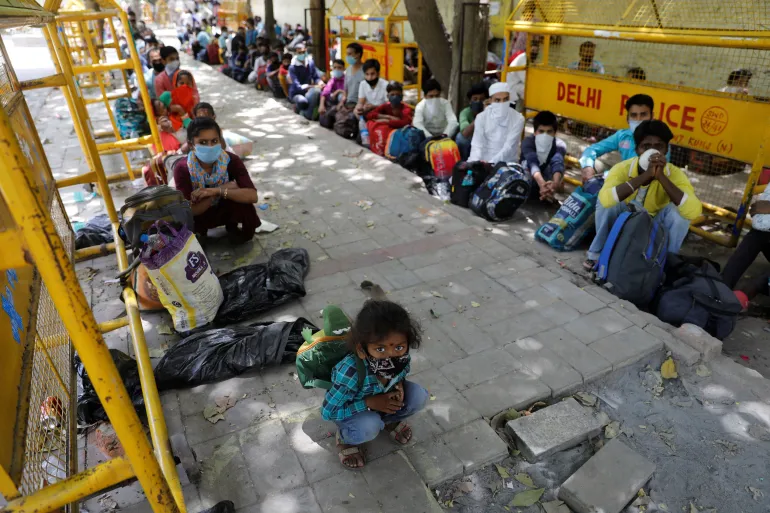
Migrant workers and families wait to board a bus for a railway station to catch a train to their home states during an extended lockdown during the COVID pandemic in New Delhi, India, on May 26, 2020 [Adnan Abidi/Reuters]
Dhiraj Nim, an economist at ANZ Bank expects the tax relief to have a 0.2 percent impact on the gross domestic product (GDP) growth.
“People will consume a little more, but they will also save more. Some personal loan repayment will happen,” he said. “I don’t think the boost in consumption will offset the one trillion rupees [$11.5bn] given in relief by too much.”
Moreover, any economic boost will be a short-term measure while the problems it seeks to address “are more fundamental”, warns Alexandra Hermann, lead economist at Oxford Economics. “There is nothing [in the budget] that addresses employment or skilling,” that will lead to broader and more sustained growth, she says. Just about 2 percent of Indians currently pay income tax and unemployment and underemployment have stayed high, she says.
Some of India’s slowdown could be attributed to a cyclical tapering in demand after the post-pandemic recovery when the economy grew sharply. Industry heads and government officials believed India was on a high growth trajectory. The country is already the world’s fifth-largest economy and is projected to become the third-largest by 2030.
But now the “issues beneath the growth” have been revealed, Cornell’s Basu says. “While there has been inequality for at least two decades, what we are seeing now has not been seen since 1947,” the year that India won its independence from the British.
Delicate economic juggle
The government has sought to spur growth through strong spending on infrastructure such as roads and bridges. But stimulus provided during the pandemic meant the government needs to tighten its belt to meet its fiscal deficit target of 4.5 percent by next year. This reduced spending could also take away from some of the boost provided by the income tax relief, Nim of ANZ says.
Modi’s US visit comes amids this delicate economic moment in India. President Trump spoke of India’s high tariffs on American cars and other products meant to protect Indian industry and create domestic jobs.
India, like Mexico and Canada, will also enter negotiations to bridge its trade surplus, but this could involve concessions that could hurt Indian industry as well as purchases it can hardly afford. (New Delhi peremptorily reduced tariffs on Harley Davidson motorbikes in the budget.)
“It is notable that the Indian government has gone out of its way to avoid tariffs,” says Michael Kugelman, director of the South Asia Institute at the Wilson Center, a Washington, DC-based think tank. “A big reason for this is the fragile economic growth.”
Cornell’s Basu suggests the rising inequality would best be addressed through “a little higher tax for the super-rich and use it to support small businesses.”
Basu also says small businesses have been affected by compliance costs for the Goods and Services Tax and could be simplified and lowered.